
are sea creatures bugs ? tales from the pod
as was determined some time in the past by seasoned bugologists (we didn't ask wormologists due to a potential conflict of interest), it was determined that worms is not bugs. the deciding factor here is the lack of a spine, with the lack of legs considered a secondary piece of evidence.
this has been universally accepted at this point. however, with classification comes questions, come vagaries. it takes a spine to be a bug, and while it does not take legs to be a bug, most bugs have legs, and so there is consensus that , in the lack of proof of a spine if it cannot be determined , a set of legs (and potentially nice bugsocks) can be accepted as stand-in evidence that the entity being observed is some sort of bug. however, in the greyzone lies a plethora of thallasic and detritivoric edge-cases. while the latter is considered too niche to be discussed at this present moment, the former is one of paramount significance ,,, one whose answer the very existence of the bugzone depends on.
while one so-called bigbookofbug remained eerily silent on the role of the oceanic denizens as members of bugkind, there was another willing to speak up and ask the hard questions.
enter the pod: the 270125 occurrence
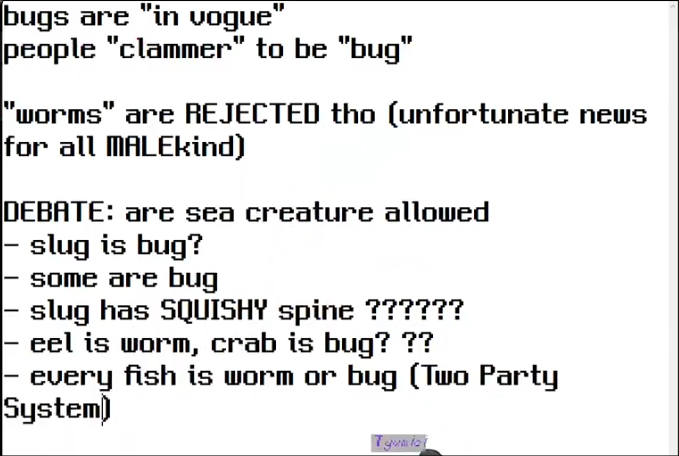
famous wired journalist prodzpod was the only one determined enough to broach this ever-difficult subject, setting forth a set of rules that were set forth by setting them forth live. this was "huge" as the kids say, and will surely send waves throughout bug history for generations to come.
it began with the observation of the status of bugs in the community. namely, their desirability. bugs are on the rise, some calling it the "new NVIDIA" in the stock world, but safe enough that it can also be used as a sort of high-yield savings account. this goes beyond just passive observation and passive income, but can be statistically validated as well. take a second and google the term "bug". tell me , dear reader , how many results are there ??? getting more specific, even searching "programming bug", you will find our shoujo protagonist is quite the talk of the town.... on monday alone , using neovim's word search on irc logs, we counted [1/>99] occurrences of the term "bug"........,,,, WOWZA
with so many seeking bugism , it is important that we "separate the wheat from the chaff" , or more accurately , "the worms from the bugs". this undertaking begins with an exploration of the sea creatures, as we see these creatures often. convening democracy-style with members of the green and green adjacent , rules regarding sea creatures were set established. based on notes from this town hall, we can conclude the following:
bugs are in vogue
sea creatures can be classed as either bugs or worms , with a good deal of them being bugs
not all sea creatures are bugs, however, as not all have a spine - there are edge-cases
eels, for example, are worms due to a lack of a spine. crabs are bugs because they are all-spine
slugs, despite their squishy appearance, are in fact bugs. it was determined via rigorous science done on stream live on stream that they have a spine ,, it is just squishy
rather than a mere exclusion of worms from the bug category ,,, worms will be wholesale rejected
wow ,,, now that's a doozy. it seems like a lot of proclamations made without any sort of basis in the science of bugology. rest assured however, there is factual evidence to back this all up. we can split the above into two parts:
addressing the popularity of bug, and why "going bug mode" is on the rise
the separation of sea creatures into either bug or worm
for the former of these two, we can use statistics and sociology to validate that the people do indeed "clamor to be bug". the latter, the categorical, relies on mathematics. namely, set theory.
who even wants to be a bug
this is probably the most important part of this whole thing. after all, if no one wants to be bug, then what's the point of this conversation? if there was no desire to aspire toward bugness, then we could pack up and leave. there would be no point to make any distinctions.
fortunately, science is on our side. leading bugologists have issued a poll to the bugzone that consisted of the following questions:
do you agree with the the following: "bugs are in vogue"
do you agree with the following: "i clamor to be bug"
if yes, why?
are sea creatures bugs
are worms bugs?
are sea creatures worms ?
Breaking down the results, we get the following:
Are bugs in vogue? yes. do people clamor to be bug? that's complex
of the participants, there was a unanimous agreement that "bugs are in vogue". if this isn't enough evidence that the question of what is and isn't a bug is of great importance, we don't know what is.
however, this, at least seemingly, is contradicted with the results of the second question: do you agree with the following: "i clamor to be bug", wherein only 34% of participants answered yes. this may seem to be a rejection of bug, but thanks to insights from famous bug BugVT, we were able to glean the following information: those who are already "bug" will answer "no" to this question. for not foreseeing this limitation in the poll, we apologize.
keeping this in mind, we can note that there is some margin of error, and there is more of a 50/50 split. even if one does not desire bugness themself, however, the fact still stands that bug is to them a very good thing.
turning quickly to the question of "are worms bugs?", we see, again, an unanimous answer of "no".
under the sea
regarding the questions of sea creatures, we see that there is a general agreement that some, but not all, sea creatures are worms and some, but not all, sea creatures are bugs. 50% of participants answered the "some" option on both of these questions. this is all fine and good, if not for the problem that this means 50% did not answer this. there was an even split between this other half of participants, with 25% believing that all sea creatures are worms, and 25% believing all are bugs.
we see here, then, that not only is it that bugs are in vogue, but there are many who are unsure of the status of sea creatures. given the lack of clarity here, we feel the need dive deeper into the question of sea creatures, bugs, and worms.
Paradoxien des Unendlichen: a mathematical approach toward bugs
broadly defined, set theory is a branch of mathematics that is concerned with the study of sets, or collections of objects referred to as elements of that set. For example, given a set X, that contains elements 1 and 2, we can write the following:
X = {1,2}

To note that an item is an element of a set, we use ∈:
1 ∈ X
2 ∈ X
Using this, we can begin to create a small set of sea creatures, a set of vertebrates, and invertebrates:
sea creachures = {sea slug, eel, octopus, stingray, Joel, crab, shark, mantis shrimp, plankton}

spineless = {eel, octopus, plankton, worm, snake}

We will separate spine-ness between squishing and solid (bouba and kiki) spinetypes:
has solid spine = {Joel, crab, shark, mantis shrimp, mantis, beetle}
has squishy spine = {sea slug, stingray, slug, snail}
so, we can classify sea characters,,,, now what ? well, dear reader, we are not done just yet. turns out Big Math has an extra trick up its sleeve involving sets ..... TWO tricks , in fact ,, one for each sleeve.
there exists as well the "union" and the "intersection." a union of two sets is a set in which all objects are a member of either of the two sets, or both sets. for example, given A = {1,2,3} and B = {3,4}, we can state A ∪ B = {1,2,3,4}.
by contrast, an intersection, ∩, of two sets is a set of all objects that are a member of both sets. Using the definitions of A and B from above, we can state A ∩ B = {3}.
and with joining , we need as well a means of splitting. for that, there is set difference, / which is a set of all the elements of one set that are not elements of the other set. taking this last operation, we can note A/B = {1,2}.
this only scratches the surface on set theory, but is enough to get us toward a sea-based proof. readers interested in further studies are implored to investigate books such as Axiomatic Set Theory by Patrick Suppes, or Introduction to Topology by Bert Mendelson.
With these new definitions at our disposal, let us define the following, based on the axioms all sea creatures are worms or bugs and worms have no spine, bugs have spine:
we take our original argument of spineless entities:
spineless = {eel, octopus, plankton, worm, snake}

and our two sets of enspined things:
has solid spine = {Joel, crab, shark, mantis shrimp, mantis, beetle}
has squishy spine = {sea slug, stingray, slug, snail}

this can be reduced like so:
enspined = solid spine ∪ squishy spine

to define sea creasher with spine:
enspined sea creatures = enspined ∩ sea creachures
  = {sea slug, stingray, Joel, crab, shark, mantis shrimp}

spineless sea creatures is just the difference between two sets:
spineless sea crshr = sea creachures/enspined sea creatures
  = {eel, octopus, plankton}

Taking this logic, and the above axioms, we can note the following:
  bug = enspined ∩ sea creachures = enspined sea creatures
  worm = sea creachures/enspined sea creatures = spineless sea crshr
what the freak ??? did we just devise a mathematical proof that can categorize sea creatures as bugs or worms? yes we did! now, i know some may be wondering: what about the legs? sea don't legs? ,,, well, have you considered that fin is a type of foot, and you need leg to have foot ? i rest my case
that does, of course, leave sea slugs, which lack fins. however, we can note that these are gastropods which quite literally means foot stomach. i rest my case, again.
conclusion
wow , that was a lot, but we had to ensure that all bases were covered when it comes to the question of sea creatures, given the frequency at which this question occurs, and the general confusion regarding it. at the conclusion of this, we hope the reader feels more wizened to the nature of sea creatures, and how some can be bugs, and some can be worms. we have also provided, via mathematical proof, a sound way to determine which ones are which: all that is needed is knowledge of the presence of a spine.
psssst....